New York State leads the nation in historic tax credit utilization, processing more projects in the last decade than another other state. At the center of this activity is Preservation Studios, a Buffalo-based firm that has managed over half of the state’s historic tax credit projects over the past ten years, representing $1.4 billion in total reinvestment.
This volume of projects highlights both the large inventory of historic buildings still awaiting renovation and the growing complexity facing adaptive reuse developers in post-industrial cities. As the most straightforward candidates for redevelopment are completed, preservation specialists are now tackling more challenging properties that demand creative and flexible solutions.
From Architecture Ambitions to Preservation Practice
Michael Puma’s career in historic preservation began with early aspirations to become an architect, influenced by a family that valued history and architecture. However, his experience with contemporary architectural practice led him to reconsider.
“I realized I’d be spending most of my time designing generic commercial buildings rather than significant works of architecture, which people rarely commission anymore,” Puma says. “Historic preservation offered a middle ground. I get to work with a range of beautiful to utilitarian structures, all of which are just as interesting to me.”
This mindset is increasingly common among preservation professionals who view adaptive reuse as a way to work with meaningful architecture while meeting practical development needs. Puma joined Preservation Studios in 2011 and became a partner in 2013 alongside Derek King and their former partner, Jason Yots. The firm has grown to seven employees, with additional interns and part-time staff, and now handles projects throughout New York State with on-going expansion into other markets like Florida, California, Rhode Island, and Pennsylvania.
Rising Project Complexity in a Stable Market
Despite economic fluctuations, New York’s historic tax credit market has remained steady. “Every year we wonder if things will slow down, but it’s just as busy as the past years, if not busier,” Puma notes.
However, the types of projects have changed. “Most of the obvious ones have been done or are underway, and now we’re moving on to the next tier. These require more creativity – they aren’t always straightforward conversions anymore.”
This shift is evident in recent work, such as a large factory complex on Buffalo’s east side where about 60% of each floor had to be replaced due to severe deterioration. “I never thought the building would get done – it was in such bad shape. Seeing it turn around was something I thought was years away,” Puma recalls.
Lessons from the Monroe Building
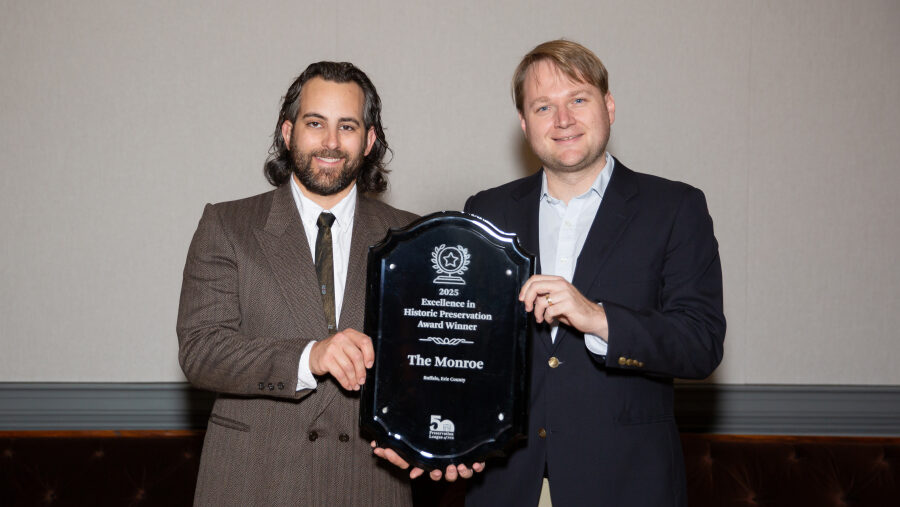
Preservation Studios’ own development of the Monroe Building highlights the difficulties adaptive reuse projects face in today’s market. Initially planned as all commercial space, the project underwent several changes due to disruptions from COVID-19 and broader market instability.
“We closed in December 2019, with financing set for March 2020. Then the pandemic hit, and the project was put on hold for about two years. We faced unexpected carrying costs because of COVID,” Puma explains. The development team included Preservation Studios, Urban Vantage, and Common Bond Real Estate, all comprised of long time colleagues in related fields.
Ultimately, the Monroe Building became a mixed-use development, with 17 apartments occupying two-thirds of its 30,000 square feet and seven commercial spaces filling the remainder. The team intentionally included more commercial space than is typical in Buffalo’s adaptive reuse projects.
“Most reused buildings in Buffalo are almost entirely housing, with little or no commercial space,” Puma says. “But this building’s location on Main Street, near a university and transit lines, made it well suited for a mix of uses.”
The project encountered steep cost increases throughout construction. “Every few months, we thought we had the budget figured out, then we’d get new pricing and costs had gone up again. We had to keep value engineering the project while trying to maintain our vision,” Puma says.
Common Developer Mistakes
Years of consulting have shown Puma that developers often make preventable mistakes when pursuing historic tax credit projects. The most significant is poor timing.
“The biggest mistake is coming into the process too late,” he explains. “We always tell clients to involve us as early as possible, ideally before purchasing the property, during due diligence.”
Preservation Studios uses due diligence to assess both the building’s historic significance and whether the developer’s plans comply with preservation requirements. “It’s not helpful if you buy a historic building and then try to force incompatible designs onto it,” Puma says.
Communication failures during construction are another frequent problem. “Plans to retain historic features often fall apart during demolition. Items that are supposed to be preserved end up being removed or discarded,” he notes.
Building Types That Pose Unique Challenges
Certain building types, especially churches, are particularly difficult to redevelop under historic tax credit rules. Restrictions prevent subdividing sanctuary spaces.
“The Secretary of the Interior’s Standards for Rehabilitation don’t let you subdivide sanctuary interiors,” Puma says. “Those spaces are defined by their volume and grandeur. If you add floors or partitions so that someone wouldn’t recognize the original space, the project won’t qualify for credits.”
Recently, however, Puma has seen the National Park Service show greater flexibility. “I just had a project approved with more division in a sanctuary space than I’ve ever seen before. There’s some hope that the Standards are being reconsidered.”
Policy and Process Improvements
Puma finds that the federal and state regulatory processes now function more smoothly, with the National Park Service becoming more accessible to applicants.
“When I started, you couldn’t really interface with the National Park Service directly – everything went through the State Historic Preservation Office,” he recalls. “That barrier has started to come down in recent years; I believe in part to the changing landscape of the industry as well as efforts by advocacy groups like the Historic Tax Credit Coalition.”
Locally, Buffalo’s permitting process still needs improvement, but Puma is optimistic. The incoming mayor is a preservationist, a shift from the previous administration, during which “we lost thousands of buildings.”
Common Misconceptions About Tax Credits
Misunderstandings about historic tax credits remain common, particularly regarding what the program covers.
“People often think only the exterior matters,” Puma says. “That’s because local landmark regulations usually only cover exteriors. But with the tax credit program, every aspect is reviewed – interior, exterior, systems, and finishes.”
Negative perceptions often come from developers who ignored professional guidance and tried to force through unacceptable plans. “When someone complains about a bad experience, it’s usually because they were told multiple times their approach wouldn’t work, but they kept pushing anyway,” Puma explains.
Opportunities and Challenges Ahead
Looking forward, Puma sees significant redevelopment opportunities on Buffalo’s east side, where he has lived for over a decade after rehabilitating a historic home slated for demolition. However, he stresses the need for sensitivity to longtime residents.
“There’s a lot of potential, but also a lot of risk because the area has experienced severe disinvestment. Developers have to avoid displacing existing communities and understand the needs of the people here already,” he says.
The downtown office-to-residential conversion trend seen in other cities hasn’t yet taken off to the same extent in Buffalo, mainly due to a lack of amenities and residents. “You can’t get a critical mass of residents downtown until there are basic amenities, but those amenities won’t open until there are enough residents to support them,” Puma explains.
Despite these hurdles, Preservation Studios continues to advance new projects, including another co-development of additional residential and commercial space across from the Monroe Building. Redevelopment projects in the next few blocks of Main Street that Puma expected was years away, have started breaking ground, which will add another 300+ apartments and commercial space.
For developers with $2-5 million to invest in Buffalo, the opportunity is real but requires creativity, community involvement, and early professional input. The second wave of adaptive reuse in Buffalo is more complex than the first, but it offers the chance to make a lasting impact in neighborhoods that have long awaited new investment.